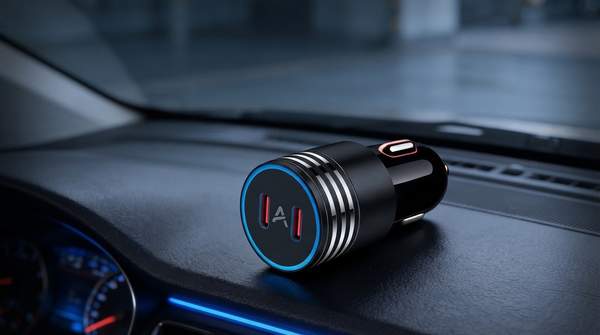
The right multi-port car charger comes down to three questions: how much total power you need, which fast-charging standards your devices speak, and where in the car that power has to reach. A 75W adapter with two USB-C ports serves a very different household than a 78W five-port hub on a six-foot cable. This guide walks through each trade-off, using real products as examples, and ends with a decision framework you can apply to any charger on a spec sheet.
Trade-off 1: Total Power vs. Per-Port Speed
The headline wattage on a charger's box is a budget, not a guarantee for each port. Anker's Nano 75W Car Charger, for instance, delivers a total of 75W, but that output is divided between its built-in retractable cable and a second USB-C port regardless of whether both are in use—the cable pushes up to 45W while the extra port tops out at 30W, as Gaurav Shukla reports for Yahoo Autos.
The same math applies with more ports, and it can bite harder. Tollefe's 78W 5-in-1 charger spreads its output across five ports—three USB-A at up to 18W each and two USB-C at up to 30W each, per Rokform's rundown. But TechGearLab's testing found the Tollefe's performance began to degrade once more than three devices were connected in specific combinations, with charging rates decreasing at each port. Unless a manufacturer explicitly states dedicated maximums for every port simultaneously—a rarity—assume per-device speed drops as you fill the ports.
Trade-off 2: Port Types and Fast-Charging Technologies
A USB-C port is a shape, not a speed. What actually unlocks fast charging is matching the charger's technology—Power Delivery (PD) for most modern phones and USB-C devices, Quick Charge (QC) for many Android phones—to what your device supports. TechGearLab's reviewer Benjamin Hickok puts it plainly: the limiting factor is the charging technology built into your device, so look up what your phone supports and match it to the port's listed specs. Most top chargers in their testing included both QC and PD, but not every model does.
Cables matter too. In TechGearLab's testing, one charger's QC 3.0 mode failed to supply correct voltage and current when a longer cable was used, while other models handled longer cables fine. And note the discrepancy in manufacturer claims: Tollefe's own product page advertises up to 20W per USB-C port, while Rokform's review credits the PD ports with 30W—check the listing you're buying from. Charging speed ultimately depends on the device's own circuitry, the cable, and the charger together; this guide focuses on the charger's role.