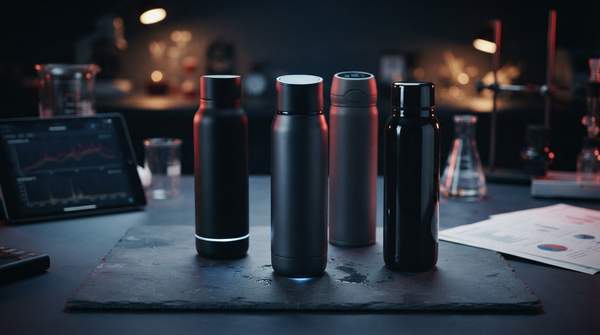
If your priority is trustworthy fluid-intake data, the HidrateSpark Steel is the strongest pick among independently tested smart water bottles: a 2018 study by Borofsky and colleagues, published in Urolithiasis, measured its tracking error at 0.0% mean percentage error. The same study found the Thermos Smart Lid was the least accurate of the bottles tested, missing many sips entirely. But accuracy is only one axis of the decision—battery life, charging habits, and reminder features vary widely, and the longest-lasting option in this comparison, the Hidrate Spark 3, runs on a replaceable coin cell rather than a rechargeable pack. Here is how the leading models stack up.
Understanding Smart Water Bottle Accuracy
The most useful accuracy evidence comes from outside the manufacturers' own marketing. In the Borofsky et al. 2018 study, researchers poured known volumes through commercial smart bottles and compared the devices' recorded intake against actual amounts. The results separated the field clearly. The HidrateSpark Steel and the H2Opal recorded a mean percentage error of 0.0% (95% confidence interval -3% to 3%), meaning their sip-by-sip measurements were highly reliable. The Hidrate Spark 3 showed consistent error values, though it tended to underestimate most sips.
The Thermos Smart Lid performed worst, with a mean percentage error of 2.0% (95% CI -10% to 14%)—and the study identified a physical reason. Its sensors do not extend through the entire bottle, so many drinking events went unrecorded altogether. That matters for anyone using a smart bottle for a medical or fitness goal: a bottle that misses sips doesn't just add small errors, it can silently drop whole drinks from your daily total. The wide confidence interval on the Thermos result also signals less predictable performance across uses.
One caveat applies throughout: these figures come from one 2018 laboratory study and may not reflect every model version or real-world condition, such as ice in the bottle. HidrateSpark states its sensing remains accurate even with ice, but that is a manufacturer claim, not an independent finding.